
HFC Meaning in Internet: Hybrid Fiber-Coax Explained Simply
It has been widely used by cable television operators since the early 1990s, and it is still a common term in internet service descriptions.
HFC meaning internet refers to hybrid fiber-coaxial, a broadband telecommunications network that combines optical fiber and coaxial cable to deliver internet, television and voice services. It has been widely used by cable television operators since the early 1990s, and it is still a common term in internet service descriptions.
The network works in two stages. Television channels and data travel from the headend to local communities over optical fiber, then an optical node converts the light signal to radio frequency and sends it over coaxial cable to subscriber homes. This combination lets operators use fiber for long distances and coaxial cable for the final connection.
Key takeaways
- HFC is a broadband architecture that uses optical fiber for long-distance transport and coaxial cable for the final connection to homes.
- An optical node converts light signals into radio frequency signals, marking the boundary between the fiber backbone and the coaxial distribution plant.
- Because HFC reuses existing coaxial plant, operators can add fiber for capacity while still serving the last stretch over coax.
- Connection quality depends on the length of the coaxial segment between the node and your address, so ask your provider how far it runs.
- Node placement and the number of subscribers sharing a node are key design decisions that directly affect the performance of an HFC network.
What does HFC stand for in internet networks?
HFC stands for hybrid fiber-coaxial, a broadband telecommunications network that combines optical fiber and coaxial cable to deliver internet, television and voice services, and this combined design is what the term describes. In practice, HFC is the term people encounter when a provider describes its last-mile infrastructure as partly fiber and partly coax. The name tells you the architecture: fiber carries the signal over long distances, and coaxial cable finishes the job close to the customer.
Hybrid fiber-coaxial as a broadband network
HFC is a broadband network architecture rather than a single product or standard. Television channels travel from the cable system's distribution facility, called the headend, to local communities over optical fiber subscriber lines. At the local community, an optical node converts the light signal into radio frequency (RF) and sends it over coaxial cable lines to subscriber homes. Cable television operators have commonly used this approach globally since the early 1990s, which is why the term appears so often in provider documentation.
Why the name combines fiber and coaxial cable
Each component does a different job. Optical fiber is efficient over long distances and carries the signal from the headend out to neighborhoods. Coaxial cable is well suited to short runs, so it handles the final segment to individual premises. Because the two media are combined, operators can reuse existing coax plant while still moving most of the traffic over fiber.
The mix changes what you should expect. If a provider's network is mostly fiber close to your home, the coax segment is short and the setup behaves much like a full fiber network. If the coax segment is long, with more amplifiers between your home and the node, service quality depends more on how well that coax plant is maintained. Ask your provider how far the coax run is from the node to your address before assuming the connection performs like fiber.
For a deeper technical walkthrough, see Hybrid Fiber-Coaxial (HFC) Explained for Engineers . The background definition is also described on Wikipedia's entry on hybrid fiber-coaxial networks .
How does an HFC network carry internet traffic?
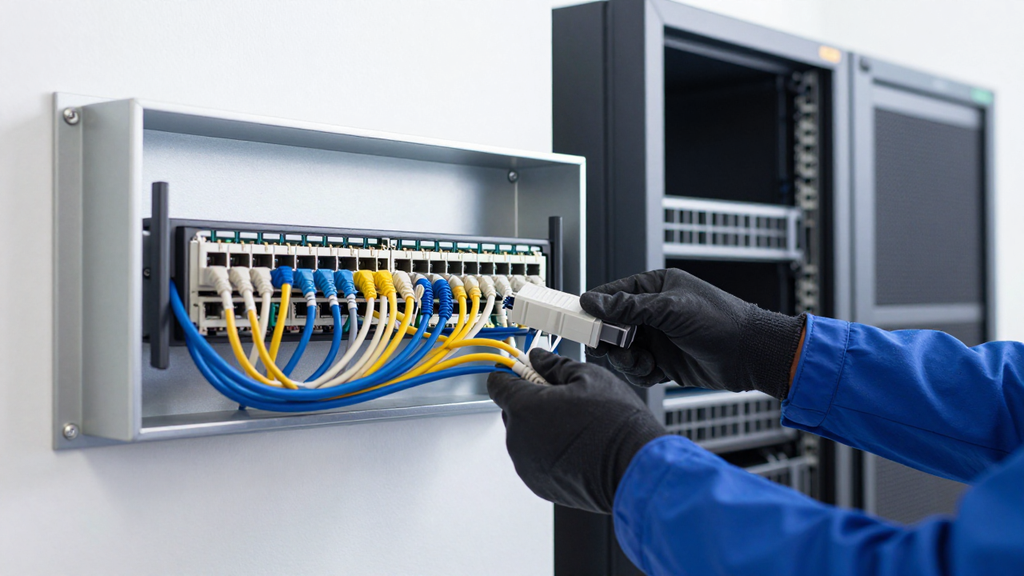
An HFC network carries internet traffic by moving signals over two media in sequence: optical fiber for the long-distance segment from the headend toward local neighborhoods, and coaxial cable for the final stretch into homes. The fiber portion handles the high-capacity transport, while the coaxial portion distributes the service to individual subscribers. Understanding this split explains most of how the network behaves in practice.
How signals travel across an HFC network
Traffic in an HFC network is carried on radio frequency signals using frequency-division multiplexing. The same cable carries analog television, digital television, video on demand, telephony and internet data on different frequency bands, which are roughly in the 5 MHz to 1000 MHz range. The network operates bi-directionally: the downstream path carries data from the headend to the home, and the upstream path carries requests and control signals back to the headend.
Because the network can carry both directions over shared infrastructure, a single HFC plant can support two-way services without a separate return system. Older one-way systems depended on telephone lines or radio links for upstream communication, which is one reason the shift to bi-directional operation mattered for internet service.
Role of optical fiber in the transport path
Optical fiber forms the backbone of the transport path. Fiber cables connect the headend or hub to the optical nodes, typically in a point-to-point or star layout, and sometimes in a protected ring. At the node, the light signal is converted into radio frequency signals that travel over coaxial cable to the subscriber.
- Headend or hub: the origin point where signals are processed and sent out.
- Fiber backbone: carries signals over distance on optical cable.
- Optical node: converts light into RF signals.
- Coaxial distribution delivers the RF signal to homes and buildings, the final step in how an HFC network reaches subscribers.
- Upstream return path: carries subscriber traffic back toward the headend.
Designers often choose the node layout based on how many subscribers share a node and how far the fiber runs. Where a node serves a small group of homes, the coaxial segment stays short and signal quality is easier to maintain. In a dense area with many subscribers per node, the shared coaxial capacity becomes the limiting factor, and operators may split nodes to add capacity.
For readers comparing providers, the practical takeaway is that HFC performance depends on both the fiber path and the local coaxial segment. For more background, see HFC Meaning: Hybrid Fiber-Coaxial Networks Explained. Teams planning fiber routes can also review Understanding Vetro Fiber in Fiber-Optic Design when mapping the backbone.
The core idea behind HFC in internet service is simple: fiber carries the traffic over distance, and coaxial cable delivers it the last stretch to the user. The two media divide the work, and each one solves a different part of the delivery problem.
What are fiber optic nodes in an HFC network?
A fiber optic node is the point in an HFC network where the optical fiber portion of the plant connects to the coaxial portion. Everything upstream of the node travels as light over fiber; everything downstream travels as radio frequency (RF) signals over coaxial cable. Understanding this boundary is the fastest way to see how internet traffic moves from the provider to a home on an HFC network.
What a fiber optic node does in the plant
The node's job is conversion. Signals arriving from the headend or hub travel over fiber as light, and the optical node translates that light into RF signals that can be carried over coaxial cables. The reverse path works the same way: upstream signals from subscribers are converted back into light for the trip toward the headend. Because the node sits at this translation point, it is the place where the fiber backbone hands off to the local distribution plant.
In practice, the node serves a defined group of homes or businesses. Its position determines how many subscribers share the same coaxial segment, which is why network planners treat node placement as a core design decision rather than a detail.
Where fiber meets coaxial plant
The fiber portion typically runs from the headend or hub toward the neighbourhood, and the node marks where that fiber ends. From there, coaxial cable distributes services to individual premises, including multi-dwelling units. This split lets operators use fiber for long-distance, high-capacity transport while reusing existing coaxial infrastructure for the last stretch.
The boundary is not always the same everywhere. In a dense area with many subscribers per segment, operators may place nodes closer together to reduce how many homes share one coaxial path. In a sparse area, a single node can cover a wider footprint. Choosing between these layouts depends on subscriber density and the cost of extending fiber, so the right node spacing is a local engineering decision.
- Receives fiber-based signals from the headend or hub
- Converts light into radio frequency (RF) signals
- Converts upstream RF signals back into light
- Feeds the coaxial distribution plant serving homes and businesses
- Defines the boundary between fiber transport and coaxial distribution
When planning or mapping an HFC route, teams often need to see exactly where each node sits relative to fiber and coaxial plant. Hybrid Fiber-Coaxial (HFC) explained for engineers covers the technical side of that layout in more depth. MapItRight offers real-time collaboration and GIS overlays, which can help teams keep node locations and plant routes visible to everyone working on the network.
How does the final connection to customers work in HFC?
In an HFC network, the final connection to customers is made over the coaxial portion of the network. Fiber carries the signal most of the way from the headend toward the neighborhood, and the coaxial cable takes over at the last stage to reach the subscriber's home or business. This is the segment that determines how the customer actually connects to the internet.
How the last link reaches a home
Signals travel from the headend or hub through fiber optic cable until they reach a fiber optic node. The fiber ends at that node, which typically serves a defined group of homes. There, the optical signal is converted into a radio frequency (RF) signal and sent over coaxial cable to the homes and businesses it serves. The node is therefore the handoff point between the two media: fiber above it, coax below it.
Coaxial drop cable from the street to homes
From the coaxial cable on the street, a small, flexible drop cable enters each subscriber's premises. This drop cable connects directly to the customer premise equipment, such as a cable modem for internet access or a set-top box for television. Coaxial cable suits this short distance well and can carry several services at once, including television, broadband internet and voice.
The practical effect for the customer is that the quality of the final connection depends on the length of the coaxial run and the equipment at the premises. If a household is served from a node with a long coaxial segment, or if the drop cable is damaged, the service may be affected even when the fiber upstream is working correctly. Operators in this situation usually check the drop and the premises equipment before looking at the wider network. For teams planning or maintaining such networks, Hybrid Fiber-Coaxial (HFC) Explained for Engineers covers the engineering view of these segments in more depth.
How does HFC compare with other internet connection technologies?
HFC, or hybrid fiber-coax, sits between two older approaches: a fully copper-based access network and a fully fiber-to-the-home design. It uses optical fiber for the long trunk run from the distribution center toward the neighborhood, then reuses the coaxial cable already installed on the street to reach each customer. That split is what separates it from the alternatives, so the useful comparison is not a list of names but a set of criteria: which medium carries the signal, where the fiber stops, and how much new cabling a provider must build.
How HFC stacks up against other access technologies
Compared with a pure fiber-to-the-home network, HFC keeps the coaxial plant in the last mile. Coaxial cable is well suited to short-distance transmission and can carry several services at once, including cable TV, broadband internet, and voice. A provider that already owns a coax plant can add fiber for the trunk and nodes without replacing every drop, which is why HFC is usually described as the lower-cost option when a network is upgraded rather than built from scratch.
The trade-off appears when you compare it with a fully fiber design. Bandwidth on an HFC segment is shared among the users on that node, so the experience can change at busy hours. A dedicated fiber line to each home avoids that sharing. For a neighborhood with a mature coax plant and moderate demand, HFC is a practical choice; for a new development or a service area with heavy simultaneous use, a fiber-to-the-home build is usually the better fit.
| Criterion | HFC (hybrid fiber-coax) | Fiber to the home | Copper DSL |
|---|---|---|---|
| Medium in the last mile | Coaxial cable | Optical fiber | Copper telephone pair |
| Fiber reach | Trunk and nodes | All the way to the home | Usually none in the last mile |
| Bandwidth sharing | Shared across a node | Typically dedicated per home | Dedicated line, distance-limited |
| Cost to upgrade an existing coax plant | Lower, reuses coax | Higher, new cabling | Varies with line condition |
Speed, latency, and reach criteria for comparison
When you compare connection types, judge them on three things. Speed is set by the medium and the amount of capacity assigned to a customer. Latency depends on how many devices and amplifiers the signal passes through before it leaves the network. Reach describes how far the signal travels before it needs regeneration. HFC performs well on reach and capacity across a neighborhood because fiber carries the long distances. The number of active components between the node and the home still shapes latency, so compare the specific plant serving your address instead of assuming one technology is always faster.
If you need to plan or document a mixed access network, Understanding Hybrid Fiber Coax covers how these segments are laid out, and What is a Network NAP explains the access points where fiber meets the rest of the network. MapItRight offers GIS overlays that let engineers view fiber and coax segments side by side when they compare these criteria on a real service area.
How have HFC networks evolved over time?
HFC networks have changed over the years as cable operators adjusted the balance between their two core technologies. The basic design, which sends signals over optical fiber from a central facility toward local neighborhoods and then over coaxial cable to individual homes, has remained in place. What has changed is how much of the network runs on fiber and how that fiber is placed. Understanding this development helps explain why discussions of HFC often focus on the boundary between the fiber and coaxial parts of the network.
How cable plant upgrades changed HFC design
HFC networks began as one-way systems in which television channels were sent from the headend to subscribers. Later, many operators added return-path capability so that signals could travel from the home back to the headend, which allowed the same plant to carry two-way data traffic. Upstream and downstream traffic can therefore share a single plant, but only if the operator has upgraded the design to support it.
For example, an older one-way plant that delivered only television would need its amplifiers and return path reworked before it could carry internet traffic reliably. Operators make this decision based on whether they want to add services to an existing cable plant or to replace sections of it. The choice depends on the condition of the coaxial plant and on how many subscribers each segment serves.
How fiber deployment changed the network structure
Fiber deployment has moved over time, with optical links extending closer to subscribers. A conventional HFC network uses fiber from the headend to an optical node, where the light signal is converted to radio frequency and sent over coaxial lines. As operators push fiber deeper into their networks, fewer amplifiers and coaxial segments sit between the headend and the home. Remote PHY is one such evolution that aims to reduce the use of coaxial cable in the network and improve signal quality.
The practical effect is that the boundary between fiber and coaxial moves. Operators who keep the node close to the coaxial segment keep more of the original design, while those who move the node further out shorten the coaxial portion.
The right approach depends on the network in question. A cable operator with a mostly healthy coaxial plant may only need targeted fiber extensions, whereas an operator with aging coax across a large service area may find that deeper fiber deployment is the more effective path. Because the cost and disruption of each option differ, the decision should rest on an inventory of the current plant rather than on a general preference for one design.
Who operates HFC networks for internet service?
HFC networks are most commonly operated by cable television operators. These companies built their infrastructure to deliver television signals and later extended it to carry internet traffic, which is why the hybrid fiber-coax design is so closely associated with cable providers. Many of these operators run networks across large regions, sometimes through organizations known as multiple-system operators.
What multiple-system operators run in HFC
A multiple-system operator, usually shortened to MSO, is a company that owns and manages cable systems in several localities at once. Instead of running a single neighborhood network, an MSO coordinates many separate HFC systems under one organization. This allows shared standards for equipment, network design, and service delivery across a wide area.
For the reader, the practical point is that an HFC connection is usually part of a larger operator network rather than an isolated local project. The company that bills you for internet service is often the same organization that maintains the fiber backbone, the optical nodes, and the coaxial plant feeding your building, which together make up the HFC network. When you evaluate a provider, knowing whether it operates its own HFC plant or resells access on someone else's network helps you understand who is responsible for outages and upgrades.
Which cable television operators deploy HFC networks
Cable television operators deploy HFC networks because the design reuses coaxial cable that was already installed for video service. Fiber is added in the upper part of the network, where it reduces the number of amplifiers needed and carries signals over longer distances, while the existing coaxial cable reaches individual homes. Operators that already own a coaxial footprint can therefore upgrade it incrementally instead of replacing the entire last mile at once.
The right way to judge a particular operator depends on your situation. If you live in an area served by an older coaxial plant with few fiber nodes, performance and reliability may differ noticeably from a newer HFC build, even when both are marketed under the same name. In that case, ask the provider how far its fiber reaches toward your neighborhood and how many customers share each node. That answer explains more about your likely experience than the operator's brand alone.
Which related internet terms should readers know alongside HFC?
Understanding what HFC means starts with three terms that appear throughout the technology: optical fiber, coaxial cable and broadband. HFC, or hybrid fiber-coaxial, is a broadband telecommunications network that combines optical fiber and coaxial cable. Knowing what each of these words means makes the acronym far easier to decode.
What optical fiber and coaxial cable mean
Optical fiber is a thin strand of glass or plastic that carries signals as pulses of light. In an HFC network, it is used for the long-distance part of the route, from the headend to local communities. Coaxial cable, by contrast, is a copper cable with a central conductor surrounded by insulation and a metal shield. It carries radio frequency signals and is well suited to short distances, which is why it serves the final stretch to subscribers' homes.
What broadband means in an HFC definition
Broadband refers to a high-capacity connection able to carry large amounts of data, video and voice at the same time. When readers see HFC described as a broadband network, the term signals that the technology is built for high-speed internet and multiple services, not a narrow voice-only link.
Plain-language meaning of HFC for everyday readers
If you only need the acronym decoded, HFC stands for hybrid fiber-coax. The word hybrid means the network uses two kinds of cable together. The fiber carries signals over the longer distance, and the coaxial cable finishes the job close to the customer. This split is the core of how HFC is designed, and it explains why the network is described as a hybrid rather than a single cable type.
Glossary of related terms tied to the HFC definition
Three terms recur in any HFC discussion. Optical fiber carries light-based signals over long distances. Coaxial cable carries radio frequency signals over short distances into homes and businesses. Broadband describes the high-capacity service these cables jointly deliver. Reading the HFC acronym in technical documents becomes straightforward once these three terms are clear.
The definition matters most when you compare service descriptions. If a provider mentions an HFC network, the cable portion is likely the part that reaches your premises, while fiber likely handles the upstream route. Checking whether the provider describes its network with these terms helps you understand what type of connection you are buying.
What does an HFC connection mean for everyday internet users?
For everyday users, an HFC connection means the internet service reaches the home through a network that combines optical fiber and coaxial cable. The fiber carries the signal over long distances, and the existing coaxial cable completes the final stretch to the customer's modem. Because most of the physical path is shared infrastructure, the connection behaves differently from a fully fiber-to-the-home line, and that difference is worth understanding before you compare plans.
Reading an internet service description that mentions HFC
When a provider's service description mentions HFC, it is telling you the access network is hybrid rather than all-fiber. The term itself is a reliable signal that bandwidth is shared among users on the same segment, which matters most during evening peaks when many households are online at once. A description that names HFC does not tell you the speed you will actually receive, so treat it as information about the network design, not a performance promise.
Questions to ask a provider about the network type
Asking directly whether your connection runs over an HFC network helps you interpret the service correctly. Useful questions include whether the last mile to your home is coaxial cable, whether the segment serving your street is shared with many neighbours, and how the provider upgrades its nodes when demand grows. A provider that can answer these clearly is giving you the information you need to judge the connection.
The network type matters less if you rarely stream high-definition video or run large uploads, but it matters more for households with several heavy users. In that case, check whether your provider's upgrade plans are documented, because shared-segment congestion is the main practical limit of an HFC line.
How the HFC meaning internet definition applies to your situation
Reading the definition of HFC on the internet as a description of architecture, rather than of speed, is the most useful habit for a non-specialist. It explains why the same technology can deliver a fast connection in one neighbourhood and a crowded one in another. For planning and network documentation work, teams using MapItRight can keep the physical layout of shared segments visible in one place, which helps when comparing how a network is built against what customers actually experience.
Frequently asked questions
Is an HFC network the same thing as a fully fiber network?
No, an HFC network is not fully fiber. It uses optical fiber for the long-distance trunk from the headend to local optical nodes, then runs coaxial cable from each node to the homes it serves. A fully fiber network, by contrast, carries light all the way to the premises. Operators with an existing coax plant often use the HFC design because they can add fiber without replacing every drop.
Why do some sources spell it as hybrid fiber–coax?
Both spellings describe the same network. Hybrid fiber-coaxial and hybrid fiber-coax are variants of one term, with the word coax being a shortened form of coaxial cable. Provider documents and engineering texts use whichever form fits their wording, so you will see HFC, hybrid fiber coax and hybrid fiber-coaxial interchangeably. The meaning stays the same: a network combining fiber and coaxial cable. A fuller background is in HFC Meaning: Hybrid Fiber-Coaxial Networks Explained.
Can an HFC network be described in simple terms to a non-technical reader?
Yes, think of it as a highway and local streets. Light travels through fiber along the main route from the provider's hub to a neighbourhood, where a node converts it into signals that move over coaxial cable the final distance into each home. This arrangement lets one network carry internet, television and voice together.
Conclusion
The HFC meaning internet comes down to one idea: hybrid fiber-coaxial is a broadband network that uses optical fiber for the long-distance route and coaxial cable for the final stretch into homes, with fiber optic nodes converting light into radio frequency signals at the boundary between the two. Because most of the internet signal you receive travels over that coaxial segment, the network type describes how your connection is built, not the speed you will actually get.
To apply this, check your provider's service description for the network type and ask whether your line runs over an HFC segment. If you are comparing access options, judge each one on reach, latency, and the capacity of shared segments rather than on the name alone. Then ask how upgrades are documented, since shared-segment congestion is the main practical limit of an HFC line.
For teams that plan or document these mixed networks, MapItRight offers GIS overlays that display fiber and coaxial segments together, so the physical layout of each service area stays visible while you compare access technologies.